Event Rules & Regulations
General Rules & Regulations
IMPORTANT INFORMATION. NEW FOR 2027.
- If you plan to deliver presentations or product demonstrations on your stand, we strongly recommend providing attendees with headsets to minimise noise disruption to neighbouring exhibitors.
- Any equipment, presentations, demonstrations, simulations or other devices producing sound must not cause disturbance to neighbouring exhibitors or visitors.
- Noise generated from your stand must be kept at a reasonable level at all times and must not exceed 3 dB above the ambient background noise, measured from a distance of 3 metres from the stand.
- All speakers and sound equipment must be positioned to face inwards towards your stand and not towards the aisles or neighbouring stands, helping to minimise noise spill and distractions.
Adult Content
The Organisers reserve the right to close a stand, at any time if an exhibitor or its stand is considered to be displaying materials of an offensive nature. Any costs associated with this act will be borne by the exhibitor.
Alcohol & Drugs
Anti-Harassment
- Verbal comments or actions related to gender, gender identity and expression, sexual orientation, disability, physical appearance, race, age, or religion;
- Use of sexual images in public spaces;
- Deliberate intimidation, stalking or following;
- Unauthorised photography or recording;
- Use of sexualised or harassing content in presentations;
- Inappropriate physical contact;
- Unwelcome sexual attention; and
- Advocating for or encouraging any of the above behaviour.
Anti-Harassment Enforcement
If an Attendee engages in harassing behaviour, or GSMA reasonably suspects that an Attendee is engaging in harassing behaviour, GSMA retains the right to take any lawful actions to maintain a positive Event environment for all other Attendees. This includes warning the offending Attendee or the expulsion of the offending Attendee from an Event, with no refund, and without any liability whatsoever. Any Attendee asked to cease harassing behaviour, is expected to comply immediately.Balloons
Balloons must comply with the Hanging Banner / Ceiling Policy and must not be mounted above stands. Balloons can only be filled with air. Please click here to read through the Hanging Banner / Ceiling Policy. Only one compressed air bottle can be kept on the stand at a time. It is the responsibility of the Exhibitor to make arrangements for the storage of further bottles. In line with the Special Activities Policy, the exhibitor must notify the Organiser at least 90 days in advance. Please click here to read through the Special Activities Policy.
Competitions, Lotteries & Draws
In accordance with clause 8.2 of the Standard Terms & Conditions, should you wish to hold competitions, lotteries, draws, games of chance or the like whether at the Event or through the Sponsorship, this will require GSMA’s consent.- Activities involving economic participation from attendees or economic prizes shall be strictly prohibited
- You are solely responsible for ensuring compliance with all applicable laws and regulations and, where appropriate, with any related guidance from competent authorities
Compliance with Authorities
Copyrights
Please note that GSMA has entered into an agreement with SGAE, AIE and AGEDI that settles any and all use of intellectual property rights managed by the aforementioned entities in the course of the Event. Exhibitors who intend to play pre-recorded background music or show music videos on their stand as a secondary or accessory manner therefore need not to apply for the relevant licenses for public performance. However, please note that live performances, dancing events, or parties are not included in the general agreement entered by GSMA with SGAE, AIE, AGEDI. Therefore, Exhibitors who wish to organise any such event, or have any doubt as to whether a license would be required, should contact the referred entities.|
|
AGEDI-AIE | SGAE | EGEDA | AISGE | AIE |
| Address: | Padre Damián, 40, 1º pl.
28036 Madrid |
Passeig de Colom, 6
08002 Barcelona |
Consell de Cent, 419, 4º - 1ª
08009 Barcelona |
Consell de Cent, 433, prtal 1
08009 Barcelona |
Plaça d’Ibèria, 4
08014 Barcelona |
| Tel: | +34 91 555 8196 | +34 93 268 9000-3 | +34 93 231 0414 | +34 93 412 7622 | +34 93 292 0555 |
| Fax: | +34 91 555 9592 | +34 93 268 9001 | +34 93 231 3336 | +34 93 265 3577 | +34 93 292 1459 |
| Email: | correo@agedi-aie.es | sociscatalunya@sgae.es | correo@egeda.com | aisge.barcelona@aisge.es | sociosbarcelona@aie.es |
Display of Logos
Dress Code at the Event
Exhibition stand staff are expected to dress in business and/or business casual attire and behave in an appropriate, professional manner. Given the Event’s global profile and their convening of an entire industry and ecosystem, exhibition stand staff come from a broad range of cultures and nations. GSMA asks that this diversity and inclusivity is reflected in exhibition stand staff choice of clothing (e.g. clothing with political slogans or military fatigues would not be appropriate attire for an Event).GSMA reserves the right to request that any exhibition stand staff alter their attire or leave the Event immediately if their appearance and/or conduct: (i) is inappropriate given the professional and global nature of an Event; and / or (ii) could reasonably be deemed to be offensive to other Event participants.
Drones and other Remote Controlled Flying Objects
- Be constructed from durable materials such as netting, wire mesh, glass, or similar materials.
- Be structurally sound and secure enough to fully contain the drone in the event of a malfunction or lose of control.
- Be designed to prevent any potential any risk of injury or damage to people or property outside the cage.
Electricity - Power Supply
Gangways / Aisles
Giveaways & Promotional Material
Exhibitors are asked not to place stickers, signs or posters anywhere in the halls other than within their own stand and on paid advertising poster sites and billboards.
Exhibitor’s representatives may not distribute promotional literature, brochures, invitations etc. along gangways or near the entrance/exits. Such activities are to be confined within the stand boundaries.
- All efforts to advertise, promote sales and operate exhibits or Sponsorship by the Exhibitor must be conducted in such a way as not to cause any annoyance or inconvenience to other exhibitors or visitors. Organising queues on the aisles is strictly prohibited
- Exhibitors are to ensure stands are kept in a clean and tidy state for the duration of the Event
- Exhibitors are not permitted to distribute, exhibit or advertise any third-party materials, items or services at the Event
The Organisers reserves the right to stop any Exhibitor from performing any of the mentioned activities or any activities in conjunction with the above. It is the Organisers sole discretion to remove any material or cease any activity.
Minors
Noise Policy
- Any equipment, presentations, demonstrations, simulations or other devices producing sound must not cause disturbance to neighbouring exhibitors or visitors.
- Noise generated from your stand must be kept at a reasonable level at all times and must not exceed 3 dB above the ambient background noise, measured from a distance of 3 meters from the stand.
- All speakers and sound equipment must be positioned to face inwards towards your stand and not towards the aisles or neighbouring stands, helping to minimise noise spill and distractions.
Outboarding & Suitcasing
Suitcasing: The practice of companies or persons who attend shows as attendees but 'work the aisles', soliciting business from other attendees and exhibitors.
Outboarding: Non-supporting companies which set up exhibits or events at off-site locations, such as hotel hospitality suites or nearby restaurants, and encourage attendees to leave the show floor and spend time with them. Both practices are strictly prohibited at the event. For the good of the show and the exhibitors supporting the event, the only legitimate area to conduct business during event hours, is within a contracted exhibition or hospitality space within the Venue. Companies shall not suggest or encourage an event participant to attend a location outside the venue, in order to conduct business.
Parties & Events on your Stand
Photography & Filming
In accordance with clause 14.9 of the Standard Terms and Conditions for Exhibition, Advertising and Sponsorship, GSMA grants you consent for photography and filming subject to the following conditions:
a. You commit to carry out such activities solely and exclusively during the Event open days; and during the following times 08:30-19:00 Monday to Wednesday and 08:30-16:0 Thursday for all venue locations;
b. You commit to seek permission from the organiser should you wish to carry photography and filming activities outside these times;
c. You commit not to carry out such activities during build-up and dismantling;
d. You commit not to carry out such activities in any restricted or embargoed areas (i.e. if a company is getting ready to unveil a new product);
e. You commit to take photographs or make recordings exclusively of your own space (exhibition stand, meeting room, hospitality area, etc.). Regarding the content made, you become solely responsible and liable for:
- Those individuals (employees or subcontractors) and equipment involved in making the content;
- The use of such content, which shall ensure full compliance with current legislation on privacy and personal data protection and any other applicable laws;
- Requesting appropriate consents and authorizations from any third-party involved in the content made for the publication and dissemination of such content by obtaining the corresponding third-parties’ image rights. GSMA reserves the right to request the Company a proof of evidence of such consent collection.
f. You commit not to take photographs or make recordings of other third-parties’ spaces;
g. You commit not to place tripods or other stationary photographic or video equipment and cabling outside any exhibition/hospitality space or in public gangways;
h. You commit to obtain and maintain official insurance as required by the Standard Terms and Conditions for Exhibition, Sponsorship and Advertising; and
i. You commit not to use wireless devices that can interfere with the Venue Internet services (for example wireless microphones or cameras). For more information, please check the Wireless Policy
Failure to comply with the above mentioned conditions, may result in (i) your Company incurring in a material breach of the obligations assumed under the Terms and Conditions for Exhibition, Advertising and Sponsorship; (ii) the content made (original and any copy) be handed over to the Organizer for the sole purpose of its destruction; and (iii) eviction of your Company or the offending party from the venue and not allowed re-entry to the Event or any future Events organized by or on behalf of the Organisers.
Press Access
Queuing
Placement and Stand Boundaries
All devices must remain strictly within your stand space.
Placing devices in public aisles, gangways or communal areas is strictly prohibited, as this can obstruct attendee flow and poses a safety risk.
Any device found outside your stand space may be shut down immediately and reported to venue security.
Repeated violations may result in suspension of your company’s event passes and/or disconnection of your stand’s power supply, at the discretion of the Organisers.
Device classification
All robotic devices are classified into one of two categories based on a single question:
Is the device physically separated from attendees at all times during operation?
If the answer is yes, the device falls under Category 1. If the answer is no, Category 2 applies.
- Description of activity and setup.
- Stand layout with device location and exclusion zone dimensions.
- Photos or videos of the device in operation.
- Barrier specification, including material, height and attachment method.
- Name and contact details of the responsible person on the stand.
2. In proximity to or interacting with attendees (Category 2)
The device operates in shared space with attendees, or attendees may approach, touch, or directly interact with it during operation. If a device can operate in both modes, it is classified as Category 2.
Operating in Category 2 requires that the device has functioning safety systems appropriate for operating near people, and that these systems can be verified onsite. If these systems are not in place, cannot be demonstrated, or are found inadequate during the onsite inspection, the device must operate exclusively behind a fixed barrier under Category 1.
A trained operator must be present at all times, able to activate the emergency stop immediately and without obstruction. The operator must remain dedicated to supervising the device.
Interactive functions such as speech, gestures and recognition may be AI-driven. However, the device’s movement must follow a predefined, controlled path. Autonomous navigation — where the device determines its own movement near attendees — is not permitted.
- Description of activity and full attendee interaction scenario.
- Stand layout with device operating area, attendee access points and operator position.
- Photos or videos of the device in operation.
- Risk assessment covering all applicable hazard groups.
- Name and contact details of the responsible person on the stand.

Smoking
Smoking is not permitted inside of any part of the Fira Gran Via Premises. This applies to build-up, show open days and dismantling.Special Activities Policy
This section covers activities that require advance approval, goods and equipment that are restricted, and how to request approval where needed. It exists to ensure these activities take place safely and in compliance with event Health & Safety requirements.
Overview and approval workflow
A special activity is anything beyond a standard demonstration, presentation or display — typically something that involves movement, physical participation, vehicles, performers, or equipment that needs to be checked on site.
When the Special Activity Form is required
An activity requires submission of the Special Activity Form if it meets any of the following:
- It involves a motorized or self-propelled vehicle, such as self-driving cars or vehicle demonstrations
- It involves performers, artists or acrobatics
- Participants move physically, turn 180–360 degrees, or use props or objects as part of the experience This includes certain VR, AR and MR activities
- It requires a physical installation, structure or simulator with moving parts that need on-site checking
- It involves direct physical interaction between attendees and a device, machine, substance or element — beyond simply viewing, hearing or touching a screen
If the activity does not meet any of the above, no submission is required. If you are unsure, submit the form and the Organiser will confirm whether any further action is required.
On-site inspection
All approved special activities will be inspected on site by the Health & Safety Team. The team may ask additional questions or require confirmation of safety measures.
Queue management
Special activities must not generate queues or gatherings of attendees that extend beyond the stand footprint. If the activity is likely to attract significant interest, the Special Activity Form must include a queue management plan that keeps attendees within the stand.
Related regulations
The following activities have their own dedicated regulations. Refer to the relevant section rather than submitting a generic Special Activity Form:
- Drones and remote-controlled flying devices — see Drones and Remote Controlled Flying Objects. A separate Drone Application Form is required
- Robotic devices and automated machinery — see Robotic Devices. A separate Robotic Devices Form is required
- Virtual Reality / AR / MR — for immersive activities and participant interaction.
Special Activities & Prohibited Goods
The following goods and equipment are restricted on the exhibition floor.
Strictly prohibited
The following are notpermittedunder any circumstances:
- Flammable liquids or gases.
- Naked flames, including candles and torches.
- Compressed gas cylinders.
- Radioactive materials and radiation generators.
- Explosive,pyrophoricor spontaneously combustible materials.
- Smoke machines.
- Any activity involving water where there is a risk of legionella, such as water features or fountains.
Restricted with conditions
The following are permitted only where the stated condition is met, or where specifically agreed by the Organiser in advance:
- Animals.Not permitted for demonstration purposes or as part of any activity. Registered service animals are permitted; contact customersupport@4yfn.com in advance.
- Hazardous materials.Toxic, corrosive, irritant,harmfuloroxidisingsubstances are not permitted. Small quantities of domestic cleaning products in containers or aerosols under 500 cc are allowed.
- Lasers.Only Class 1 lasers or lasers in fully enclosed equipment are permitted.
- Equipment causingodouror objectionable noise.Permitted only where theodouror noise is contained within the stand and does not affectneighbouringstands or attendees.
Virtual Reality
In conducting VR, AR or MR activities, an Exhibitor must adhere to the following guidelines:
- Activities must only take place in a safe environment
- Exhibitors must ensure the area is completely free of any objects, walls, furniture or other items that participants can bump into or knock down when using the headset
- Trained staff must be present at all times to ensure best practices and supervise the activity to ensure the participant’s safety
- Participants should not handle sharp or dangerous objects while in the experience
- Screens that are on / adjacent to the aisles are not permitted to be used for VR, AR or MR in order to avoid congestion in the gangways
- If the activity requires a queue system or a large gathering of people, this must be included within your stand footprint
Exhibitors must ensure that participants in VR, AR or MR activities are fully aware of the health and safety warnings pertaining to such activities including through the use of safety signs to inform attendees of such risks.
Exhibitors are solely responsible for all risks and liabilities associated with any VR, AR, MR or other activities conducted at its stand.
|
Important: Exhibitors must submit the Special Activity form if the Virtual Reality (VR), Augmented Reality (AR), Mixed Reality (MR) planned activity involves any of the following: • The participant’s engagement in any physical activity while engaging in the VR, AR, or MR activity
|
Waste Separation for Exhibitors
Exhibitors have the option to separate their waste on their stand into paper waste, packaging and mixed waste for recycling. If you wish to do this, please visit The Exhibitor Care Help Desk South Entrance, Level -1. Full bags have to be left in the nearest gangway at the end of the day for separate collection.Waste separation colour code:
| Paper | Blue Bag
|
| Packaging | Yellow Bag
|
| Mixed Waste
|
Black Bag
|
Wheeled Transportation
Wireless Policy: Wi-Fi 2.4 GHz / 5 GHz / 6GHz (EU band)
- Wi-Fi access points, also known as Wi-Fi routers
- Mobile hotspots (sharing your mobile Internet connection, thus creating a Wi-Fi network)
- MiFi devices
- Beacons
- Wireless microphones and/or cameras
- Any other device that uses the unlicensed 2.4GHz / 5GHz / 6GHz (EU band) spectra
Wireless Policy: Cellular Frequencies and Microphones
There are a limited number of frequencies available to be shared by the exhibitors, as a result the frequency coordination team will coordinate the different slots to reduce interference between exhibitors. Power restrictions may also apply.
It is necessary to apply in the following circumstances:
- The equipment intended for demonstration will broadcast a radio frequency at any band other than Wi-Fi spectrum (2.4 - 5 GHz - 6Ghz (EU band))
- When planning to use wireless microphones and walkie-talkies. This type of equipment requires band allocation and coordination to avoid interference between exhibitors, even though they can be used in unlicensed bands. Please note microphones without the required licence will not be permitted for use onsite.
- It is NOT necessary to apply for a frequency when using a commercial SIM card from an operator or for Wi-Fi devices
- Contact the Frequency Coordination team of the Event at the following email address mwcbarcelona.frequency@firabarcelona.com, with the requirements
- If ordering microphone frequencies contact Microphone Coordination Team of the Event at mwcbarcelona.mics@firabarcelona.com with the requirements
- Exhibitors must report both wired and wireless demonstrations even if demonstrations use licensed/unlicensed spectrum
- Once your request is approved, a spectrum allocation fee needs to be paid through the Fira Store. For each frequency band requested, one unit of Frequency Management Fee product must be ordered. For Microphones the fee includes a pack of 6 units of Mics.
- The product is under Internet & Connectivity > Internet equipment & additional Services > Frequency Management Fee / Microphone Frequency Management
- The deadline to order cellular frequencies is Friday 29 January 2027
- The deadline to order microphone frequencies is Friday 12 February 2027
- We recommend the use of professional digital microphones within the bandwidth ranges permitted by current Spanish regulations:
- We do not recommend the use of analogue microphones. In high-density multi-venue coordination, we cannot guarantee sufficient free spectrum space for this type of transmission.
- List of non-recommended microphones:
- Sennheiser EW G2/G3/G4
- Shure SLX
- Shure ULXP
- If you need Wi-Fi or use Wi-Fi bands, please refer to the Wireless Policy: 2.4 GHz / 5 GHz / 6Ghz (EU band)
- The demonstrations cannot interfere with other licensed telecommunication services
- Each exhibitor must be in condition to control the emission power of their radio equipment during any time that the spectrum is in use (including build up and validation testing, etc.)
- The maximum e.i.r.p limits stipulated in Appendix 1 will be applied
- The assigned frequencies will be confirmed around Tuesday 23 February 2027, with the official confirmation from the Spanish Frequency regulator around Tuesday 16 February 2027
- A time scheduling policy would be applied if there are not enough frequency bands
- Assigned frequencies can be used from Monday 1 March 2027 to Thursday 4 March 2027
- All the emissions must finish at the end of the Event
- Please note that there is a specific advice section on how to coordinate and set up your audio-visual equipment for avoiding interference with other systems. Exhibitors can find this information in the Audio Visual Frequencies Interference section in this manual. Please click here to view this section.
|
Channel width |
Maximum mean e.i.r.p. density |
Maximum peak e.i.r.p. |
|
Below 1,5MHz |
- 80 dBm/MHz or -146 dBm/Hz / channel |
- 70 dBm |
|
1.5 to 5MHz |
- 80 dBm/MHz or -143 dBm/Hz / channel |
- 70 dBm |
|
5 to 10 MHz |
- 80 dBm/MHz or -140 dBm/Hz / channel |
- 70 dBm |
Appendix 2
General Safety Regulations
GSMA and Fira Barcelona take the responsibility of creating an environment, that is as safe as reasonably practicable, very seriously. Creating such an environment is a collaborative effort involving all organising parties, exhibitors, suppliers and contractors.
All exhibitors have a legal obligation to ensure that all applicable laws and regulations are competently followed by all staff, agents and contractors; and to create a safe working environment in and around their stand space. Failure to do so can lead to fines and prosecutions.
This section has been produced to provide exhibitors with clear, simple suggestions for understanding and implementing a suitable and sufficient safety management programme to comply with Health & Safety procedures.
COMPULSORY HEALTH & SAFETY DOCUMENTATION
Important note: Whilst forms are provided as a guide, completion of these does not necessarily mean they will be approved. All Risk Assessment’s, Method Statement’s and Health & Safety Declaration’s must be compliant, suitable and sufficient. When completing your documents, please take into account as much as reasonably possible, all risks and hazards associated with your activities at the Event, in particular the construction and dismantling of any structures. All of these risks must be assessed to an acceptable level.
|
ALL EXHIBITORS (regardless of the contract type) |
Space Only stands |
|
Health & Safety Declaration |
Health & Safety Declaration |
|
Safety Risk Assessment Form** |
Manage My Contractor |
|
Special Activities Form * |
Stand Plan Submission |
|
|
Safety Risk Assessment Form |
|
|
Method Statement Form |
|
|
Double Deck Health & Safety Form* |
|
|
Special Activities Form * |
Health & Safety Declaration
Employer duties in no sense are reduced when exhibiting at an Event, therefore all health & safety at work regulations must still be complied with.
Exhibitors are legally responsible for any person working on their stand and their actions, or inactions. Exhibitors must ensure that all contractors are competent and will work in a safe manner. Exhibitors are advised to request copies of their contractors Health & Safety Policy. For smaller companies who may not have such documents, Exhibitors are advised to request copies of public liability and employee's insurance documents for reference. Exhibitors are advised not to contract with companies who cannot provide such documents.
Safety Risk Assessment
Do this for the build-up, exhibition open days and dismantling. Weigh up whether you have taken enough precautions or should do more to prevent harm. The important aspect is whether a hazard is significant, and whether you have covered it by satisfactory precautions and controls, so that the risk is small.
If you are building a stand, your risk assessment must also include a detailed analysis of all the risks associated with your stand build, fitting and removal (e.g., working at height, use of tools, risk of fire, hazardous substances, heavy loads, live electricity, etc); and again what precautions and control measures you will implement in order to lower the risk to a safe level.
If you are building a large or complicated stand, or are involved in unusual activities during the exhibition, you may need to seek the assistance of a qualified Health & Safety professional.
The following is your step-by-step guide to completing a risk assessment:
Ask yourself:
|
Potential hazards:
|
- Who will be affected by your work and at most risk?
- Who are your employees, contractors or exhibitors on or near your stand?
- How will your visitors be affected?
- Groups include staff, contractors, guests, venue service staff, among others
Step 3: Evaluate the risks
Write down the significant hazards and conclusions. You must also tell your employees about your findings. You should be able to demonstrate that you have made a suitable assessment by identifying what the main hazards are, who might be affected, that the precautions are reasonable, and the risk is low.
Step 5: Review your assessment
Review your assessment and revise as necessary, inevitably new plans may develop and new observations may be made which could lead to new hazards requiring an assessment. It is good practice to review your assessment from time to time to make sure precautions are working effectively, allowing you to learn by experience.
Method Statement
In all stand-building cases (especially steelwork erection and lifting), the foreman and / or the principal contractor should draw up a specific method statement and go through it with your contractors in advance of the event.
Stand Plan Submission
Manage My Third Party
Special Activities
CATERING
Catering during Build-up & Dismantling
Catering Facilities on Stands
All kitchen spaces must adhere to the following:
- Floors and walls must be in good condition, without cracks and easy to clean
- Roofs must be provided over food preparation areas
- Sufficient lighting must be provided to allow work to be carried out in a safe manner
- A sink must be installed with drinkable water, equipped with antibacterial soap and paper towels
- All handling surfaces must be smooth, non-permeable and easy to clean
- Any areas being used to handle or store food must be designed to allow enough room to work and not located in walkways
- Food temperatures must be maintained as per the guidelines, hot food over 65ºC / 149ºF; cold food under 4ºC / 39ºF
- Office temperature should be a maximum of 25ºC / 77ºF
- Waste bins must have automatically activated lids with bin liners
EMERGENCIES
In the event of an emergency inside the Fira Gran Via venue, please call (+34) 93 233 4100 during event opening hours. English speaking staff will be available.
If you have a security emergency outside of the venue please call (+34) 900 77 2027.
This is a free 24-hour Security telephone number for assistance, operational from 1-4 March 2027.
First Aid
If you need to report an accident or require any form of medical assistance within Fira Gran Via including an Ambulance please call Security Control on (+34) 93 233 41 00. Do not call ambulances directly in such cases, as Fira Security will co-ordinate all incidents within the venue.
It is important to give the following information when requiring medical assistance in order for them to deal with the incident quickly and effectively:
- Exact location of the casualty – e.g. Stand name & number
-
Type of incident, e.g. cut, broken limb, faint or suspected heart problem
GENERAL HEALTH & SAFETY REGULATIONS
- A person must be appointed to be responsible for health and safety matters on the stand
- Your staff and contractors should be constantly reminded by you of the need for vigilance regarding health and safety to themselves and those working in their vicinity
- Stand construction contractors must comply fully with the legal requirements that are relevant to their operations
- The understanding of emergency & evacuation procedures and the location of the first aid centre
- The need to maintain emergency exits and keep gangways clear during build-up and the breakdown
- Ensuring that good housekeeping is maintained in work areas, thereby minimising risks and allowing any remaining hazards to be identified easily
- The work area must be free from general waste materials, as they could be a hazard. All waste should be disposed regularly and in line with the Waste Removal Policy
- Nails and other sharp object must not be left protruding from any packing cases or material
- The need for personnel to wear suitable protective clothing relevant to their job, which includes head, eye, hearing, hand and foot protection, as well as high visibility clothing, as necessary
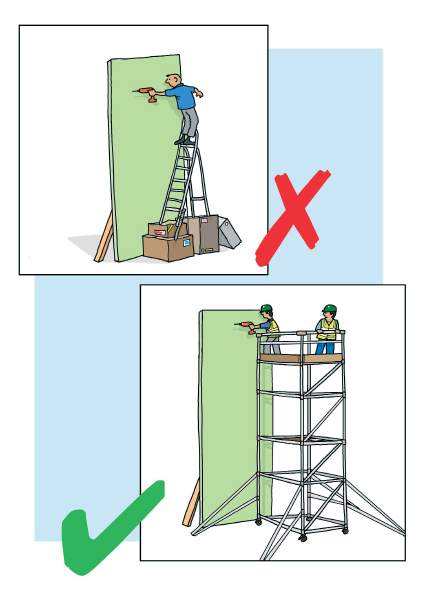
- Working at height must be done in a safe manner, using suitable equipment in the approved way, e.g., step ladders, mobile scaffold towers and harness' as necessary
- All portable power equipment must be used only for the purpose for which it was designed, with the correct safety guards, dust collection systems and other safety devices fitted and being used. Trailing power leads must be kept to a minimum and not cross gangways, unless protected at source by a residual current device. Petrol powered equipment must not be used
- Ensure power equipment is not used by anyone other than fully trained and qualified personnel. All equipment and machinery must comply with the relevant standards
- Ensure the safe use and storage of flammable liquids and substances and isolate from waste and other risk areas
- Ensure chemicals and flammable liquids are safely removed from the hall after use. Under no circumstances may such products be placed in general rubbish bins and skips
- The consumption of alcohol is not permitted in the venue during the build-up and dismantling periods
- All contractors must be aware of the need to identify suitable and sufficient tools and equipment required for the job before coming on-site
Accidents
Gangways
- All gangways must always remain unobstructed and accessible
- Under no circumstances will any part of your stand, furniture, exhibits or displays be allowed to project beyond the boundary of your stand
- No doors or windows shall open outwards onto a gangway
- Night sheets must be tied securely and neatly throughout the day and avoid obstruction to gangways
- Building across gangways is not permitted, without prior written agreement with the Organisers
g-Guide
The Organisers have adopted The Guide to Global Standards of Health and Safety at Exhibitions as minimum standard of health and safety that all venues, exhibitors and contractors should abide by. Exhibitors are advised to download the g-Guide and ensure that this information and relevant training is provided to all personnel who will be working at the stand. Please click here to download the g-Guide.Ladders
|
 |
| Important: Continued noncompliance with this regulation may result in a suspension of construction activities for a designated period. |
Personal Protective Equipment (PPE)
| Important: All exhibitors and contractors in the halls during build-up and dismantling must wear appropriate PPE (Personal Protective Equipment) |
- Access to the venue is prohibited without wearing a hard hat and a high visibility vest with the exception of the Sunday before the event
- Robust footwear should be worn in the halls during build up and dismantling to prevent slipping and foot injuries. Pumps, heels of any kind (including trainer heels), wedges and open toed shoes such as sandals and flip-flops – are NOT permitted during build up and dismantling.